All Case Studies
🏆 Hackathon — First Place

Climate Data · Hackathon · UX

Counter Culture Coffee

Coffee, climate, and data science — an 8-hour hackathon designing a communications system for Guatemalan coffee farmers facing climate change.

My Role

UX Designer — Chat Flow Design,
Systems Thinking, Presentation

Team

2 Developers, 1 Designer (me),
2 Climate Change Adaptation Experts

Climate change hits hardest where technology is scarcest

This hackathon tackled the real-world problem of climate change impacts on coffee farming using real-world datasets from NOAA & NASA weather data and demographics from Population Explorer. Hosted by The Collider and Counter Culture Coffee, participants were asked to imagine themselves as Guatemalan farmers with limited access to technology and accurate forecasts.

The farmers' entire livelihood is built around productive coffee harvests. Too little precipitation and yields will be low — too much introduces threats like erosion, nutrient leaching, and mold growth. Knowing the forecast is a critical tool for agricultural success.

The goal of the 8-hour hack was to develop short-term (weeks) and long-term (months) precipitation and temperature forecasts for Guatemalan coffee farmers using massive datasets from NOAA, NASA, and demographic sources.

An additional constraint that sharpened every decision: the target audience had limited access to technology — shared desktops at co-ops and cellular phones restricted to SMS. This pushed the team to dig for low-tech solutions to a massive problem.
A different angle: resilience over prediction

While most teams started honing in on building models to predict future weather patterns, our team focused on predicting precipitation through a wider lens — building resilience. This reframe became the foundation of our entire proposal.

Resilience of what?

Coffee yields — the primary livelihood of small-scale Guatemalan farmers.

Resilience to what?

Extreme weather events — heavy rain, drought, and wet harvest seasons.

Resilience for what?

To help small-scale farmers sustain their livelihoods in the face of increasing climate challenges.

Resilience through what?

A communications system providing actionable information and peer-to-peer knowledge sharing.

Our proposal

Create a communications system to benefit small-scale coffee farmers in the face of climatic shocks and stressors — collecting and sourcing data and disseminating it as actionable information. Utilizing SMAP & NOAA Seasonal climate forecast data, the system could share soil moisture trends, one-month, and three-month forecasts. Everyone with a phone could participate as "sensors" on the ground, sharing climate observations with one another.

SMS Chatbot

Send actionable forecasts and collect on-the-ground observations via text message.

Printed Calendars

3-month weather calendars displayed in co-ops and delivered directly to farmers.

Radio Announcements

Broadcast forecasts and community tips via local radio to reach the widest audience.

Designing the SMS chat flow

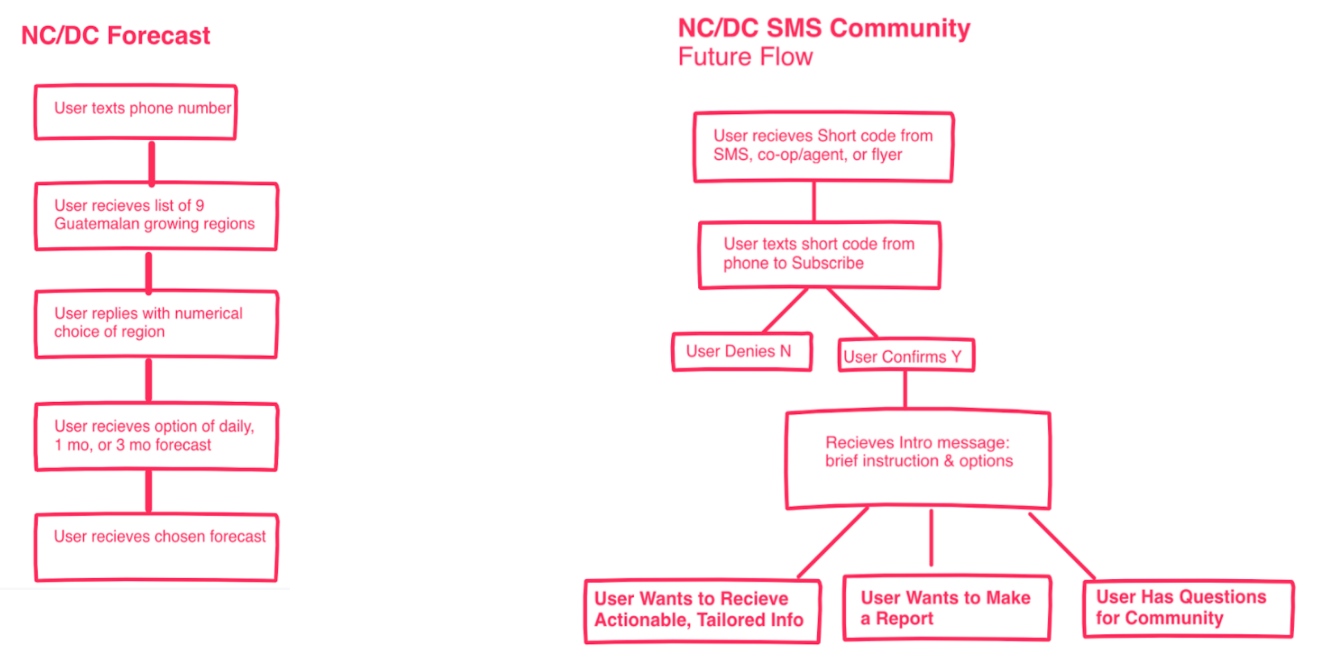
My primary contribution was designing the chatbot flow. For the hackathon demo, the team created a simple forecasting flow — but the "future flow" design showed what a more complex system could look like, where users can request specific information, make reports, and ask questions peer-to-peer.

SMS as the equalizer. Designing for SMS forced us to strip every interaction to its essential information — no UI, no visuals, just clear language and structured flows. A great constraint.

Two-way data flow. The system wasn't just broadcasting forecasts — it was collecting ground-truth observations from farmers, creating a feedback loop that improves data quality over time.

Lo-tech by design. The printed calendar and radio announcement channels were intentional — not fallbacks. Reaching farmers without smartphones required deliberate multi-channel thinking.

NC/DC Forecast SMS flow and future community flow diagrams

UX wins the hackathon — and makes a point

I arrived in the morning without a team and felt out of place in a sea of data scientists. By the end of the day, my UX skills had helped bridge the knowledge of my teammates, adding depth and human-centered direction to the project. Our cobbled-together interdisciplinary team won the hackathon.

The team that came in second also had a UX designer on board. It seems that having human-centered approaches brought both projects from raw data to applicable solutions — while many data science-focused teams spent the day sorting through endless climate data without landing on a meaningful deliverable.

If all teams had included UX professionals, would the competition have been more leveled? This hackathon made a compelling case for interdisciplinary collaboration in data science and climate work.

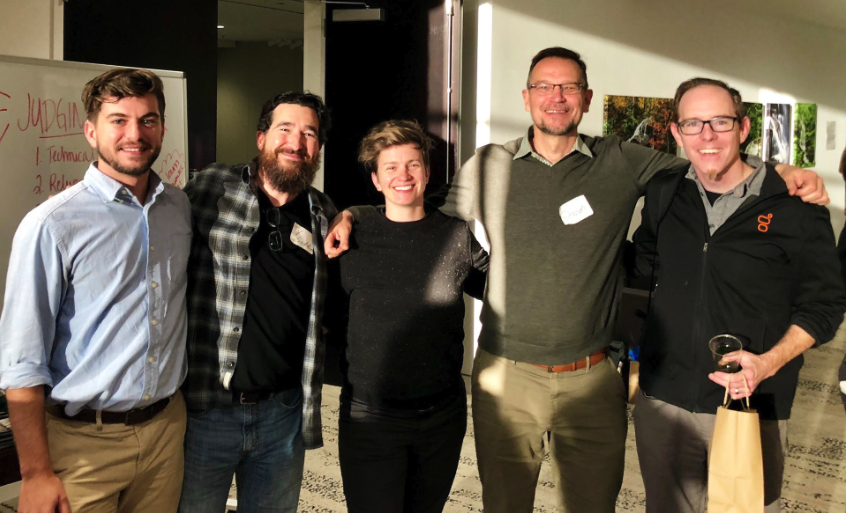
The winning hackathon team celebrating after the event

Back to First Case Study

Fresh Connect